Wuwangdun Site
Introduction
The Wuwangdun Site, located in Huainan, Anhui Province, China, is an archaeological site of immense historical and cultural significance. It is recognized as the largest, highest-ranking, and most structurally complex tomb of the Chu state ever excavated. Dating back to the late Warring States Period (475–221 BC), the site encompasses an area of approximately 1.5 square kilometers and is surrounded by a protective moat. The centerpiece of the site is the No. 1 tomb, a monumental structure believed to belong to King Kaolie of Chu (290–238 BC). This tomb, along with its accompanying chariot pits, sacrificial pits, and smaller tombs, provides invaluable insights into the history, culture, and burial practices of the Chu state during its final years.
The Wuwangdun Site has been a focal point of archaeological research due to its remarkable preservation and the wealth of artifacts unearthed during excavations. These discoveries include bronze ritual vessels, lacquerware, musical instruments, wooden figurines, and inscriptions in the Chu language. The site has not only deepened our understanding of the Chu state's social and political organization but also shed light on the broader cultural and historical developments of ancient China during a transformative period.
Historical Background
The Chu state, one of the most powerful vassal states during the Warring States Period, ruled a vast territory along the middle and lower reaches of the Yangtze River for nearly 800 years. It was known for its rich cultural heritage, distinctive burial practices, and significant contributions to the development of Chinese civilization. At its zenith, Chu was a dominant force in ancient China, but it eventually succumbed to the rising power of the Qin state, which unified China in 221 BC under Emperor Qin Shi Huang.
In 241 BC, King Kaolie of Chu moved the state's capital eastward to Shouchun (modern-day Shouxian County in Huainan) to distance it from the Qin state's growing influence. However, despite this strategic relocation, Chu was ultimately defeated by Qin in 223 BC, marking the end of its reign. The Wuwangdun Site, located approximately 15 kilometers from the ruins of Shouchun, serves as a testament to the Chu state's enduring legacy and its cultural and political significance during its final years.
Archaeological Discoveries
Excavation Process
The Wuwangdun Site has been the subject of extensive archaeological investigations, particularly following a series of grave robberies that compromised the integrity of the site. In 2015, a major looting incident prompted authorities to initiate a rescue excavation in 2020 to protect and study the remaining artifacts. The excavation was led by the Anhui Provincial Institute of Cultural Relics and Archaeology, with support from the National Cultural Heritage Administration and other institutions.
The excavation process involved meticulous planning and the use of advanced technologies to ensure the preservation of fragile artifacts. Infrared cameras were employed to decipher ink inscriptions on burial chamber cover boards, while innovative methods were developed to extract and conserve delicate items such as bamboo mats. The site also benefited from the establishment of an archaeological building in Huainan, which houses state-of-the-art conservation laboratories for the study and preservation of various materials, including lacquerware, textiles, and organic remains.
Key Findings
The No. 1 tomb at the Wuwangdun Site is a square structure with a central burial chamber surrounded by eight side chambers, arranged in a cross-shaped layout. This nine-chamber design represents the highest level of burial architecture during the Warring States Period. The chambers were covered with four layers of planks, some of which bore ink inscriptions that provided valuable information about the functions of the chambers and the cultural practices of the Chu state.
Among the most significant discoveries at the site are over 3,000 artifacts, including:
Bronze Ritual Vessels: A large collection of bronze items, including a massive ding (ancient cauldron) with a diameter exceeding 88 centimeters, the largest of its kind ever found in a Chu tomb.
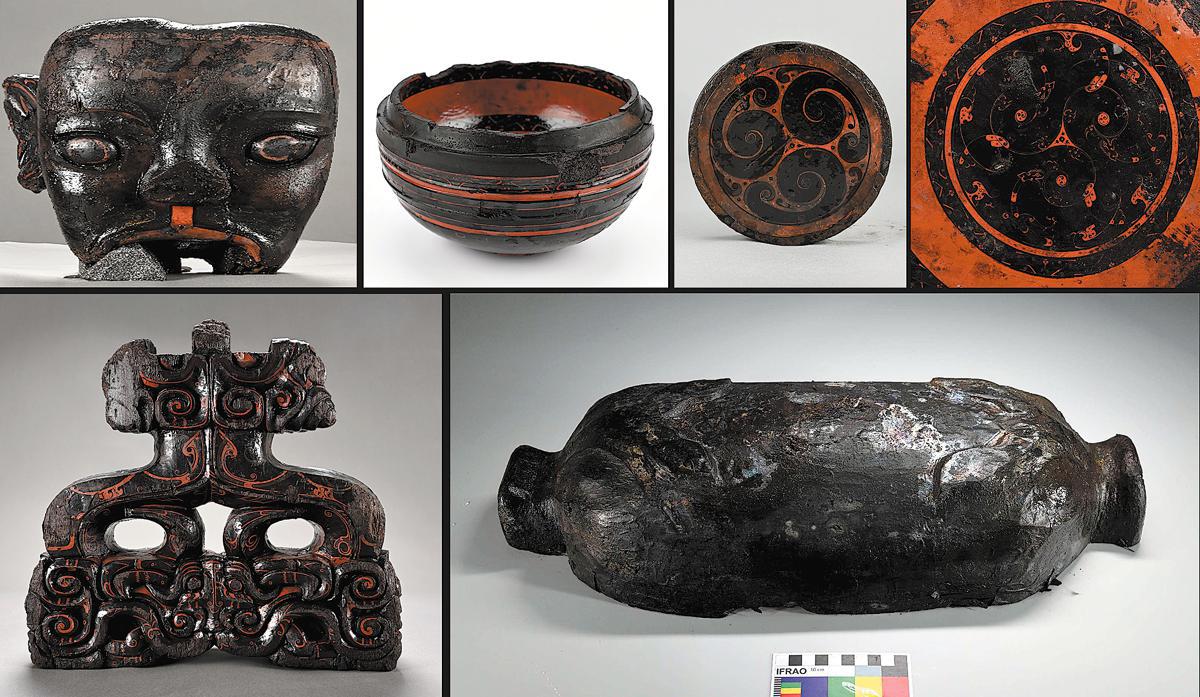
Lacquerware: Numerous lacquered objects, such as basins, plates, and statues of tomb-guardian beasts, showcasing the advanced craftsmanship of the Chu artisans.
Musical Instruments: Instruments and dancing figurines, found in a chamber adorned with inscriptions related to music, highlight the cultural and artistic achievements of the Chu state.
Wooden Figurines: Intricately carved wooden figures, possibly representing attendants or deities, were discovered in the side chambers.
Bamboo Mats: A large-scale extraction project recovered 78 bamboo mats, some measuring up to 7.5 meters in length, making it the largest ancient bamboo mat extraction project conducted worldwide.
These findings provide a comprehensive view of the Chu state's burial practices, social hierarchy, and cultural achievements during a critical period in Chinese history.
Cultural Significance
The Wuwangdun Site holds immense cultural significance as a repository of Chu state heritage and a window into the social, political, and artistic developments of ancient China. The site's unique architectural features, such as the nine-chamber layout and 21 levels of inwardly recessed steps, reflect the hierarchical nature of Chu society and its sophisticated construction techniques.
The artifacts unearthed at Wuwangdun, particularly the bronze vessels and inscriptions, underscore the continuity of Chu culture and its influence on the broader Chinese civilization. The site's proximity to Shouchun, the last capital of Chu, further highlights its historical importance as a symbol of the state's resilience and cultural identity during its final years.
Moreover, the Wuwangdun Site provides valuable insights into the transition from the Warring States Period to the Qin Dynasty, a transformative era in Chinese history. The discoveries at the site contribute to our understanding of the processes that led to the unification of China and the formation of a centralized state under the Qin and Han dynasties.
Preservation Efforts
Preserving the Wuwangdun Site and its artifacts has been a priority for archaeologists and cultural heritage authorities. The establishment of an archaeological building in Huainan, equipped with advanced conservation laboratories, has played a crucial role in safeguarding the site's treasures. These facilities enable the study and preservation of delicate materials such as lacquerware, textiles, and bamboo mats, ensuring their long-term protection.
In addition to conservation efforts, plans are underway to develop an archaeological ruins park at the Wuwangdun Site. This initiative aims to showcase the site's historical and cultural significance to the public while promoting tourism and education. The park will serve as a platform for disseminating knowledge about the Chu state and its contributions to Chinese civilization.
Influence on Modern Studies
The Wuwangdun Site has had a profound impact on the field of archaeology and the study of ancient Chinese history. Its discoveries have provided systematic archaeological data for understanding the high-ranking tomb systems of the Chu state and the cultural developments of the late Warring States Period. The site's artifacts and inscriptions have also enriched our knowledge of the Chu language, rituals, and artistic traditions.
Furthermore, the Wuwangdun Site has helped resolve long-standing debates about the construction techniques and burial practices of the Chu state. For example, the nine-chamber layout of the No. 1 tomb has provided new insights into the organization of Chu tombs and their symbolic significance.
The site's findings have also contributed to broader discussions about the origins and development of Chinese civilization. By connecting the cultural practices of the Chu state to those of the Qin and Han dynasties, the Wuwangdun Site has illuminated the processes of cultural integration and unification that shaped ancient China.








